Secret Scanning Is Becoming a $12 Billion Market by 2033
The source code secret scanning market is projected to reach up to $12 billion by 2033, and AI-powered detection tools are already hitting 97% accuracy in identifying real threats.
Secret Scanning Is Becoming a $12 Billion Market by 2033
The source code secret scanning market is on track to reach $12 billion by 2033, and organizations need a plan for protecting themselves in 2025.
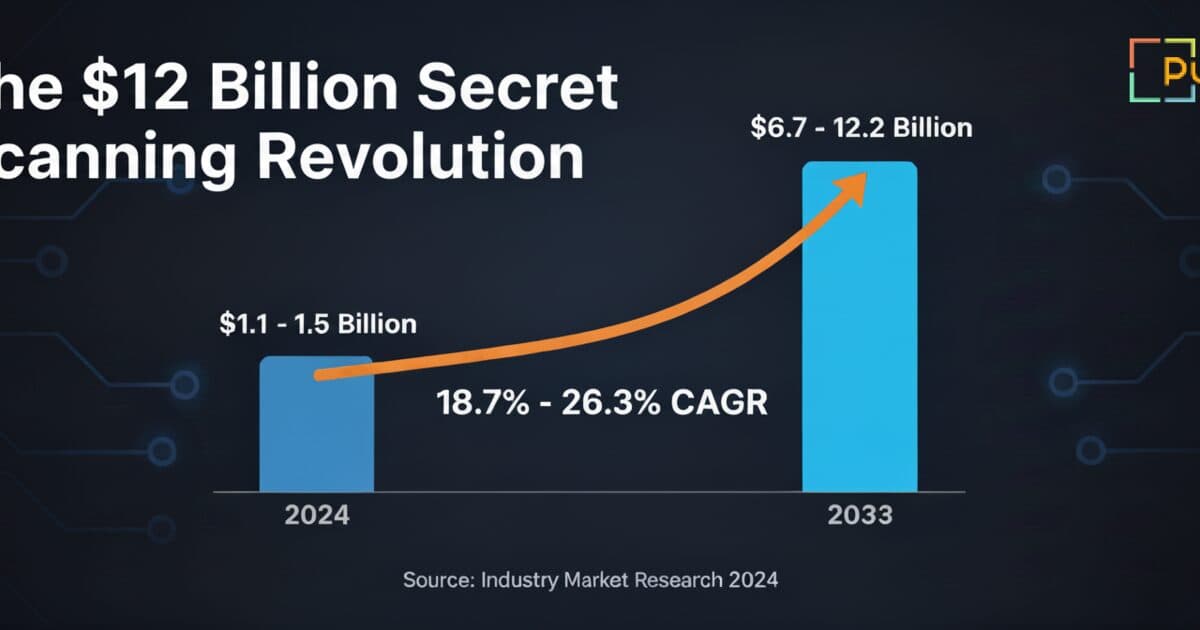
Recent vendor research puts the broader secrets-scanning market at about USD 1.45 billion in 2024, with a 2033 forecast of USD 12.18 billion (26.3% CAGR in that report). Narrower "source code only" cuts are smaller; treat $12B as the high end of a paid forecast, not a measured spend figure. Artificial intelligence is a major driver of that growth: it is changing how teams detect and prevent secret leaks in code.
Exposed secrets are a common, costly problem
Executive teams often focus on external threats while secrets quietly pile up inside their own codebases. GitGuardian detected 12.8 million new secret occurrences in public GitHub commits in 2023, a four-fold increase since they started reporting. Its scans also found millions of unique secrets, not just repeat copies of the same key.
Every exposed API key, database credential, or authentication token is a potential breach. IBM's Cost of a Data Breach series is the checkable dollar figure: USD 4.88 million globally in 2024, then USD 4.44 million in 2025. Older posts used $4.35 million from an earlier year.
Traditional secret scanning tools generate 25-30% false positives. That alert fatigue causes security teams to miss real threats while developers get overwhelmed with noise.
How AI changes secret detection
Modern AI-powered secret scanning platforms are hitting 97% accuracy while cutting false positives to 3-7%. Unlike simple pattern matching, these systems read code context and semantic meaning, and they keep learning from new threat patterns.
At Puaro Security, our AI-driven platform combines 1,500+ detection patterns with machine learning to catch secrets that traditional tools miss, like this one:
// Traditional tools miss contextual secrets like this:
const token = process.env.API_TOKEN || "hf_cAtyJKLMvj5fG19nHZxcVbnOPQR";

// Puaro's AI understands the context and flags the fallback value
One customer, a security engineer at a growing startup who asked to remain anonymous, told us: "We discovered three AWS keys exposed in our public repository that had been there for months. If we had been using Puaro from the beginning, we would have prevented potential access to our entire cloud infrastructure."
Why 36% of organizations are adopting DevSecOps
36% of organizations currently use DevSecOps, up from 27% in 2020, and 96% plan to adopt it. That shift is about more than compliance: as attacks increase, keeping up with DevSecOps is becoming necessary just to stay secure.
The cost and time savings
- 60% reduction in security costs through automation
- 12+ hours saved per week on manual security tasks
- 40% reduction in unresolved vulnerabilities with AI-powered detection
The competitive advantages
Strong security can also close deals faster once prospects see it in place. It does not have to slow developers down, and it can make regulatory compliance closer to automatic than burdensome.
The technology driving this growth
Three types of technology are behind this growth:
1. AI-powered context analysis
This approach moves beyond simple regex matching to read code semantics and developer intent.
2. Real-time integration
These tools plug directly into CI/CD pipelines and give instant feedback without disrupting the workflow.
3. Intelligent risk prioritization
Machine learning ranks threats by exploitability and business impact instead of just flagging that a secret exists.
What this means for your organization
Whether you are a startup protecting your first million in funding or an enterprise safeguarding customer data, manual and traditional secret scanning approaches are becoming obsolete.
The organizations succeeding here share a few traits: they use AI-powered detection instead of pattern-matching tools, build security into developer workflows rather than bolting it on, treat developer experience as part of security effectiveness, and track success by fewer false positives rather than only by threats caught.
Where Puaro fits in this market
As this market grows, Puaro Security focuses on combining AI-driven detection with a good developer experience:
Puaro completes a full repository analysis in seconds, not minutes.
Puaro raised 15 alerts on the OpenSSL corpus in our April 2026 comparison while a common regex scanner raised 8,449 — fewer noisy alerts, not a catch-rate claim.
There is no infrastructure to set up. Puaro is cloud-hosted and works right away.
Puaro uses 1,500+ detection patterns, continuously updated using machine learning.
Puaro integrates with GitHub and GitLab. Bitbucket is planned.
Beyond catching secrets, Puaro's AI adapts to your team's workflow and needs.
Your next step in a $12 billion market
AI-driven secret scanning is already widely used today. Organizations that adopt it now gain an edge in security, compliance, and developer productivity; those that wait tend to end up managing breaches instead of preventing them.
Getting started with AI-powered secret detection
- Start with our free plan, ideal for individual developers.
- Teams get an always-free tier with no credit card required.
- Organizations can request an enterprise demo for full deployment.
Adoption of AI-powered secret scanning is happening either way. The choice organizations face is whether to be early adopters that capture the benefits, or late adopters that respond to incidents after the fact.
Contact our security experts to learn how Puaro can help protect your organization with AI-powered secret detection. Comparison context is on Why Puaro. Plan limits are on pricing.