How AI and ML Improve Secret Detection Accuracy and Reduce False Positives
AI and machine learning models can adapt to new secret patterns and read surrounding code for context, cutting false positive rates from around 25-30% with traditional regex scanning to 3-7% with AI/ML-enhanced scanning.
How AI and ML Improve Secret Detection Accuracy and Reduce False Positives
AI and machine learning models can learn far more secret patterns than a fixed set of regular expressions, and they can read the surrounding code for context instead of matching in isolation. That combination is what separates modern secret scanning from the traditional kind: traditional scanning typically runs a 25-30% false positive rate, while AI/ML-enhanced scanning brings that down to 3-7%.
Keeping a codebase secure means making sure sensitive information such as API keys, passwords, and other secrets never ends up exposed. Code secret scanner applications exist to catch that kind of exposure. IBM's Cost of a Data Breach series is the checkable dollar figure if a live key is the first access: USD 4.88 million globally in 2024. Artificial intelligence (AI) and machine learning (ML) are changing how well scanners can do that job.
The challenge of secret management
In modern software development, secrets are everywhere. They authenticate and authorize access to services, databases, and APIs, so managing them securely matters, but it's not simple. Developers often commit secrets to version control by accident, exposing them to anyone with repository access, and that can lead to serious security breaches, including unauthorized access to sensitive data and services.
Traditional secret-scanning methods, like regular expressions and manual code review, are often not enough. They're error-prone, slow, and don't scale well on large codebases, which is where AI and ML come in.
The role of AI and ML in secret scanning
Enhanced detection capabilities
AI and ML algorithms are well suited to pattern recognition and anomaly detection. By training on large sets of known secret patterns alongside normal, non-secret code, they can learn to identify secrets accurately. Unlike traditional methods, they adapt to new patterns and variations, so they can catch secrets that don't follow a predefined format.
// Traditional regex might miss this obfuscated API key
api_key = "sk_" + "live" + "_" + "51HxTr" + "YuiOpL" + "kJhGf"

// But AI/ML can detect patterns across concatenation
// and identify this as a potential Stripe API key
Reducing false positives
False positives are one of the biggest problems in secret scanning. Traditional methods often flag benign code as if it contained secrets, which wastes developers' time chasing alerts that turn out to be nothing. AI and ML models can be trained to tell real secrets apart from non-sensitive information, which cuts down on false positives significantly and lets developers focus on genuine security issues instead of false alarms.
Traditional Scanning 25-30% false positive rate
AI/ML-Enhanced Scanning 3-7% false positive rate
Continuous learning and improvement
AI and ML models keep learning and improving over time. As they see more data and feedback, their accuracy increases, and the scanner stays current with the patterns and techniques developers actually use.
Scalability
Modern software projects often have large codebases with thousands of lines of code, and manually reviewing all of it for secrets isn't realistic. AI and ML-powered scanners can process large volumes of code quickly, which fits well into continuous integration and continuous deployment (CI/CD) pipelines and means secrets get caught and addressed promptly instead of sitting exposed.
Context-aware scanning
AI and ML models can analyze the context around a potential secret. For example, they can tell the difference between a string that looks like an API key and a similar-looking string that's actually part of a test case or documentation. That context awareness further reduces false positives and improves detection accuracy.
# Example code that might confuse traditional scanners

# This is a real secret (ML would flag this)
aws_key = "AKIAIOSFODNN7EXAMPLE"

# But this is documentation (ML would recognize context)
print("For example, AWS keys look like AKIAIOSFODNN7EXAMPLE")
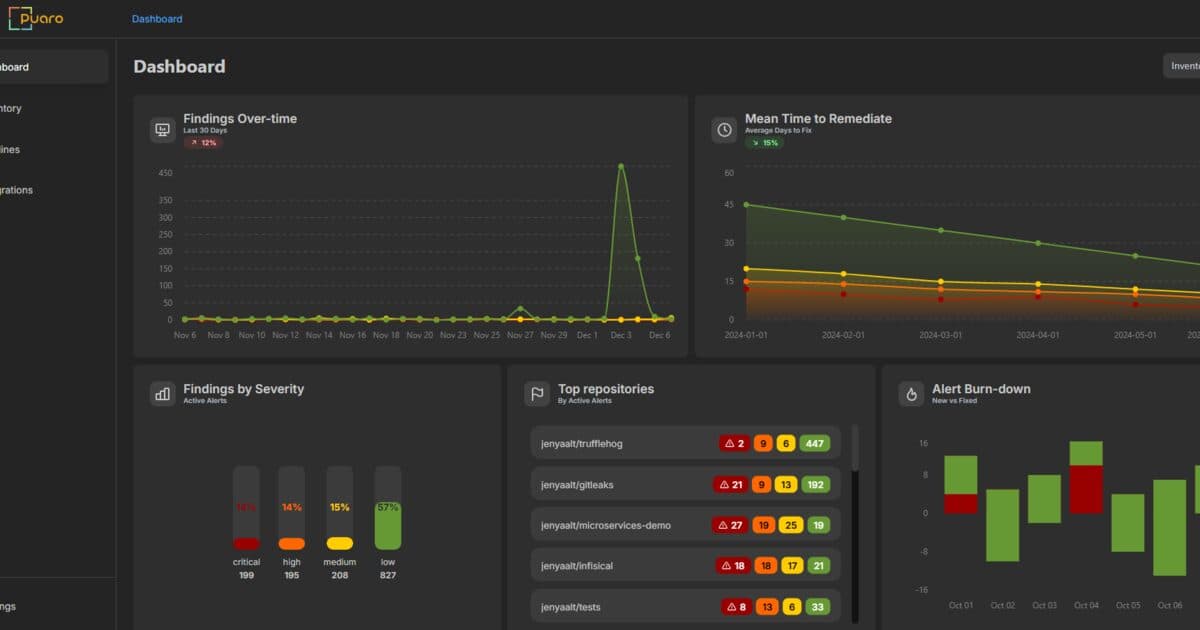
Puaro: real AI and ML-driven code secret scanner
Puaro combines several of the most advanced algorithms in the field to detect and manage secrets in codebases accurately and efficiently.
Why Puaro is unique
Advanced algorithms
Puaro combines AI and ML algorithms that go beyond simple pattern matching. They understand the context and semantics of the code, so they can identify secrets that traditional methods might miss.
Puaro's AI Arsenal
- Neural networks trained on millions of code samples
- Natural language processing for context understanding
- Hybrid detection combining multiple AI approaches
Continuous improvement
Puaro's AI and ML models are designed to keep learning and improving. By analyzing large amounts of data and incorporating user feedback, Puaro keeps its detection capabilities current and adapts to new threats and patterns to protect your codebase.
Reduced false positives
One of Puaro's standout features is how much it reduces false positives. Using advanced ML techniques, it can accurately distinguish between actual secrets and non-sensitive information, so developers can focus on real security issues instead of losing time and resources chasing false alarms.
How Puaro's ML reduces false positives
Pattern Analysis Advanced pattern recognition goes beyond simple regex matching
Contextual Understanding AI analyzes surrounding code to understand intent and context
Feedback Integration Continuous learning from user feedback improves accuracy over time
Conclusion
AI and ML have made code secret scanning meaningfully better: false positive rates drop from around 25-30% with traditional scanning to 3-7% with AI/ML-enhanced scanning, and detection keeps adapting as models see more real code. That combination matters more as codebases and CI/CD pipelines keep growing.
For organizations, investing in AI and ML-powered secret scanning tools like Puaro can be the difference between catching a leaked credential early and absorbing a costly data breach.
As codebases grow and CI/CD pipelines run more scans per day, tools that adapt to new secret patterns and read code in context will catch more real leaks with less noise than static, rule-based scanners.
Ready to see what AI and ML can catch that traditional scanners miss? Try Puaro.io.
Protect your codebase with an AI-powered secret scanner.
Ready to implement AI-powered secret detection? Contact our experts to see how Puaro's ML algorithms can improve your code security.
Context is the whole point
A regex that matches AKIA will also match a mocked key in a test fixture. An entropy detector will match a UUID in a comment. Teams then learn to ignore the channel. The ML pitch is not "we find more strings." It is "we read the surrounding code well enough to drop the ones that are not live credentials."
We still publish the measurement caveats on methodology. Internal bands are not a warranty. The April 2026 repo comparison is in the benchmark report. If you are shopping against Gitleaks or TruffleHog, use Why Puaro instead of a slogan.