The True Cost of Data Breaches
Learn from Marriott's $52 million data breach settlement how proactive secret scanning tools like Puaro can protect your organization from devastating security breaches, safeguard customer data, and prevent the astronomical costs of credential exposure in today's cyber threat landscape.
The True Cost of Data Breaches
Lessons from Marriott's $52 million settlement
Marriott's $52 million data breach settlement shows what credential exposure can cost an organization. Secret scanning tools like Puaro are built to catch exposed credentials before they turn into breaches, protecting customer data and helping organizations avoid costs like these.
Marriott International agreed to pay $52 million to 49 states and the District of Columbia, in a parallel action to an FTC order, after data breaches exposed personal information belonging to hundreds of millions of customers worldwide. The FTC order itself did not include that fine. The settlement is a reminder of what weak cybersecurity measures can cost, and why catching leaked credentials early still matters.
Key takeaway: The Marriott breach shows that credential management and automated secret scanning are not optional extras. Skipping them leaves an organization open to attacks that can be devastating.
The breach: what happened?
Malicious actors infiltrated Marriott's systems and gained access to a large amount of customer data, including:
- Passport information of 5.25 million guests
- Payment card numbers and expiration dates for 8.6 million customers
- Starwood Preferred Guest loyalty program numbers
- Personal information, including dates of birth, phone numbers, and email addresses
- Travel itineraries, room preferences, and other booking details
Beyond the settlement: the hidden costs
While $52 million might seem like a large settlement, the real impact of a breach like this goes far beyond the financial penalty:
1. Identity theft risks
The exposure of passport information and other personal details opened the door to identity theft schemes:
- Stolen passport information used to create fraudulent identities
- Criminals opened accounts or took out loans in victims' names
- Personal information sold on dark web marketplaces for premium prices
2. Financial vulnerabilities
The financial impact on customers extended far beyond the company's settlement. Compromised payment details led to unauthorized transactions and direct financial loss. Cybercriminals monetized stolen loyalty points on underground markets. Many victims also had to pay for credit monitoring services to protect themselves going forward.
3. Security token exposure
The breach also revealed the dangers of credential exposure:
- Exposed API tokens and passwords granted access to connected services
- Compromised credentials led to cascade failures across multiple platforms
- Corporate systems were infiltrated using stolen authentication details
What secret scanning could have caught
One of the most effective measures that could have mitigated this breach is automated secret scanning. These tools continuously monitor codebases and repositories for accidentally exposed secrets.
Why secret scanning matters
Early detection
- Identifies exposed credentials before they reach production
- Catches secrets in code commits before they're pushed to public repositories
- Prevents accidental exposure of sensitive information in documentation
Common exposed secrets
- API keys and tokens
- Database credentials
- Cloud service provider keys
- SSH private keys
- Authentication tokens
- Environment variables containing sensitive data
The business case for secret scanning
Some numbers show why proactive secret detection matters. GitGuardian's 2024 State of Secrets Sprawl counted 12.8 million new secret occurrences on public GitHub in 2023. IBM's Cost of a Data Breach series is the checkable dollar figure: USD 4.88 million globally in 2024, then USD 4.44 million in 2025. Older posts used ~$4.5 million; use the current IBM report when you brief finance. Human error shows up in most incidents. We do not treat "85%" as a lab number; it is a planning reminder that leaked keys are usually a mistake, not a novel exploit.
Presenting Puaro Secret Scanner
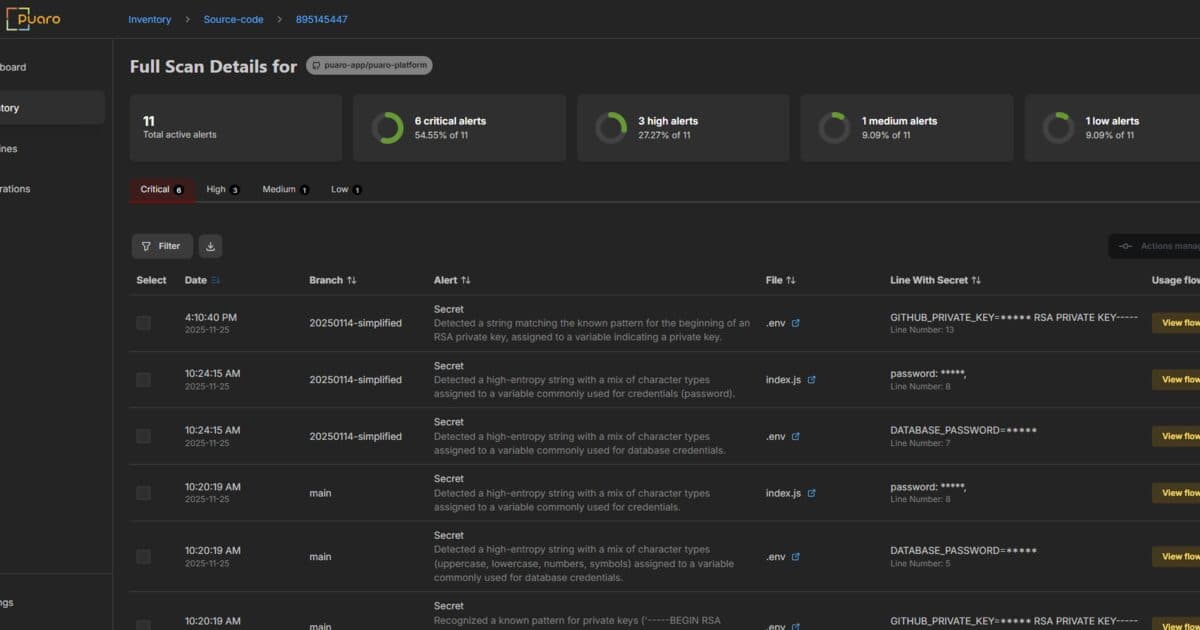
After high-profile breaches like Marriott's, more organizations are adding secret scanning to their security practices. Puaro Secret Scanner is built to catch accidentally exposed secrets before they lead to a data breach.
1. Advanced detection capabilities
- Uses pattern matching algorithms to detect secrets
- Supports multiple programming languages and frameworks
- Scans code repositories in real time
- Includes customizable rules for organization-specific secrets
- Keeps a low false-positive rate through context-aware scanning
2. Enterprise integration features
Puaro Secret Scanner integrates with common CI/CD pipelines and blocks builds that contain exposed secrets. It also sends alerts through email, Slack, and other channels as soon as it detects one.
3. Comprehensive security coverage
# Examples of secrets Puaro detects:
secrets_detected:
  - api_keys_and_tokens
  - database_credentials
  - cloud_service_provider_keys
  - ssh_and_encryption_keys
  - environment_variables
  - custom_secret_patterns
4. Business benefits
Automated scanning cuts down on the time spent on manual review, and its algorithms are tuned to minimize false positives. It scales to handle large codebases and multiple repositories, and it produces detailed audit trails and reporting to support compliance.
Preventive measures for organizations
Regular security audits
Organizations should run continuous monitoring systems, carry out periodic vulnerability assessments, and keep incident response plans up to date.
Secure credential management
Strong encryption for sensitive data, multi-factor authentication, and regularly rotated API keys and access tokens all reduce the risk of exposed credentials.
Employee training
Regular security awareness training, clear security protocols, and a security-first culture help employees avoid the kind of mistakes that lead to accidental exposure.
Moving forward: lessons from Marriott's experience
The Marriott breach is a wake-up call for organizations everywhere. As cyber threats keep evolving, companies need to prioritize cybersecurity investments, including secret scanning tools and data protection measures. Preventing a breach is always cheaper than dealing with one, in both financial terms and customer trust.
Secret scanning tools, combined with broader security practices, create multiple layers of defense against potential breaches. Security affects every part of a business, including IT, operations, and customer trust.
The cost of prevention is always lower than the price of a breach, in both financial terms and customer trust.Key takeaways from the Marriott breach
1. Early detection is critical: Automated secret scanning could have identified the exposed credentials before they were exploited
2. The true cost exceeds the settlement: Reputational damage, customer trust, and long-term business impact far outweigh immediate financial penalties
3. Comprehensive security requires layers: Secret scanning is one essential component of a robust security strategy
4. Proactive measures save money: The cost of implementing proper security tools is a fraction of breach remediation expenses
Want to add secret scanning to your security practices? Free-plan limits are on pricing. Comparison context is on Why Puaro. Or contact us.